Mostrando las entradas con la etiqueta Nivel 4 (Mañana) La Punta - Prof Mariela. Mostrar todas las entradas

jueves, 23 de abril de 2020

22/4


Hello Class! | Mrs Priest's Class Blog


 GOOD MORNING! HOW ARE YOU DEALING WITH THIS QUARANTINE?I HOPE YOU ARE SAFE AT HOME.

LET'S START PRACTICING MODALS:


Can, Could

Ability

We use can/could to describe ability, and we use can’t/couldn’t to describe absence of ability.

Possibility

We also use can to talk about possibility.

Permission

We use can/could to talk about something that is or was allowed and we use can’t/couldn’t to talk about something that is not allowed.

Requests

We us can/could in requests, i.e. when we ask somebody to do something.

Be able to

Be able to is often similar to can and we may use it instead of can to talk about ability. But be able to is more formal and is not as common.

can/could vs be able to

We can use can and be able to to talk about general ability in the present.

She can speak five languages.
She’s able to speak five languages.
We can use could and be able to to talk about general ability in the past.

My son could walk when he was 11 months old.
My son was able to walk when he was 11 months old.

But if we want to say that someone did something in a specific situation, we must use was/were able to, or managed to + infinitive.

There was a fire in the office but all the workers were able to/managed to escape. (NOT could escape)
He lost his maps but after driving around for a long time, he was able to/managed to find the place. (NOT could find)
In negative sentences, both could and be able to can be used to say that we were not capable of doing something on a specific occasion.

It was very dark and they couldn’t find the exit. (Or They weren’t able to find the exit.)

Can, Could, Be able to Quiz

1. _____ he understand what you were talking about?
 Could
 Cans
 Coulded
2. My sister _____ play tennis now.
 can to
 can
 will can
3. I _____ walk when I was less than a year old.
 can
 could
 have can
4. (Polite) _____ you tell me what time it is, please?
 Could
 Can
 Will
5. My grandfather ________ walk without any help last night.
 can
 could
 was able to
6. I would like to ________ play the piano.
 can
 could
 be able to
7. How long have you ________ drive?
 can
 coulded
 been able to
8. I'll ________ help you later.
 can
 could
 be able to
9. Can you help me? I ________ never understand this.
 can
 cannot
 am able to
10. Will people ________ live forever one day?
 could be
 be able to
 could be able to


Resultado de imagen de must and mustn't significado en español ...

Have To, Don't Have To, Needn't, Must or Mustn't Test

1- My aunt is a nurse. She ___ wear a uniform at work.
A has to
B mustn't
C doesn't have to

2- I don't like camping holidays. You ___ wash your clothes yourself.
A must
B needn't
C mustn't
D don't have to

3- My parents are on holiday. I ___ forget to take my key with me.
A must
B mustn't
C have to
D needn't

4- I ___ go to the bank today. I don't have any money.
A must
B mustn't
C  don't have to
D needn't

5- We have a gardener so you ___ look after the plants. He can do it well.
A need
B needn't
C can
D can't

6- ________ your father have to go to work tomorrow?
A Does
B Do
C Has
D Must

7- What time ________ home on Mondays?
A you has to leave
B does you have to leave
C you have to leave
D do you have to leave

8- We are in a museum. You ________ take photos without permission!
A must
B mustn't
C have to
D needn't

NOW, GO TO THE WORKBOOK AND PRACTICE ON PAGE 24,25 AND 26.

HAVE A GREAT WEEKEND!


martes, 21 de abril de 2020

21/4

 Welcome back !

TODAY WE ARE GOING TO TALK ABOUT MODAL VERBS. 

Modal verbs add meaning to the main verb in a sentence by expressing possibility, ability, permission, or obligation

Here are some characteristics of modal verbs:
They never change their form. You can't add "s", "ed", "ing"...
They are always followed by an infinitive without "to" (e.i. the bare infinitive.)


Aptis Grammar: Modal Verbs | Aprender ingles vocabulario ...

Watch the following video


Now let's go to the Student's book :

Page 34 3A

1.a Answer the questions and send me an audio in private to practice speaking.
b.Read and complete exercise c.

Page 35 

2. Vocabulary related to travelling by plane 
Read  the text and guess the meaning of the words bold and then check the  mening with a dictionary.

3.Read carefully the grammar chart and complete the exercise 4 .Practice. (read the situation and form sentences using the modal in brackets.) 

Page 36  3B

Read and complete th exercises.b,c and d

Page 37 

2. Vocabulary: word building

A lot of nouns are formed by addding a suffix (-ion,-ation, -ment,--al) to a verb . complete the exercise.

3.Grammar: read carefully and complete.

4.Look at the signs and write sentences using the modals mentioned.

5.speaking: practice speaking asking and answering as in the example.


jueves, 16 de abril de 2020

16/4

APRIL 16TH

Welcome back

Review 

   a) Choose the correct option
  1. We  at the breakfast table when the doorbell .
  2. He  a lot of friendly people while he  in California.
  3. When they  the museum, the sun .
  4. The students  cards when the teacher  in.
  5. While the children , their parents  TV.
  6. It  to rain while she  the flowers in her garden.
  7. When I  the door, it .
  8. While Henry  a drink at the bar, his wife  in the sea.
  9. He  a loud bang while he  to his friend.
  10. While he  a shower, his dogs  his steaks. 
  11. b) Put the verbs into the correct tense (simple past or present perfect simple).
    1. A: (you / taste / ever)  sushi?
    2. B: Yes, I (eat)  sushi at least five times so far.
    3. A: When (you / eat)  sushi for the first time?
    4. B: I (eat)  sushi for the first time on my dad's 50th birthday. He (invite)  the whole family to a Japanese restaurant.
    5. A: (you / like)  it?
    6. B: Absolutely. In fact, it (be)  so good that we (be)  to that restaurant three times yet. And on my mum's birthday, we (order)  some sushi and (have)  it at home.

  12. Now, complete the Round Up on page 3o and 31 in the student's book.
  13. Workbook 22 and 23. 


martes, 14 de abril de 2020

14/4

April 14 th

WELCOME BACK!

Pay attention:

These words are often used with the present perfect tense, although they can be used with other
tenses.

We use ever in interrogative sentences:
Have you ever been to the United States?
Have you ever traveled by train?
Have you ever failed a class?

We use never in affirmative sentences, but the meaning is negative, it means NUNCA
- I have never cheated in an exam.
- My son has never been to Moscow.
- My brother have never gone to London.

In sentences with the verb in negative, we use ever instead of never.
- I would't ever say that.
This is the same as saying: I would never say that.
With other word with a negative meaning, we also use ever intead of never.These words are: withouthardlynobody/no onenothing.
Without ever seeing him.
- I hardly ever do that.
Nobody would ever do that.
Nothing is ever ready on time.

We use just to express a recently completed action, and it means ‘a short time ago’.
In the present perfect, ‘just’ comes between the auxiliary verb (‘have’) and the past participle.
- The cat has just caught a bird.
- The guests have just arrived.
- I have just finished my homework.

We use already to express that something has happened sooner than expected. Already’ usually comes in mid-position.
- Don't forget to bring your book! Oh, I have already brought it.
- The boys are going to pack, aren't they? No. They have already packed.
- Is Adam going to buy a new car? No, he isn't. He has already bought it.
Still is used to talk about something that hasn’t finished – especially when we expected it to finish earlier. It usually comes in ‘mid-position’.
          - I’ve still got all those letters you sent me.
Still is often used with other tenses as well as the present perfect.
- She is still working.
- The baby is still asleep.
- We are still wainting for his reply.
- It is still raining.
- Are you still working in the bookshop?

We use yet in interrogative and negative sentences. In interrogative sentences, it means the
same as already, and
 is used to talk about something which is expected to happen. In negative sentences, it is the same as still, and it suggests a time later than expected.
Have you finished your homework yet? No, I haven't done it yet.
Has your father seen your report? No, he hasn't seen it yet.
Have the visitors arrived?
 No, they haven't arrived yet.

We use For when we measure the duration – when we say how long something lasts: For + a period of time
To measure a period of time up to the present, we use the present perfect tense
and not the present tense.
have known her for a long time. (Correct) 
know her for a long time. (Incorrect)
- have lived here for ten years. (Correct)
live here for ten years. (Incorrect)
The present tense with For refers to a period of time that extends into the future.
How long are you here for? (Until when)
How long have you been here for? (Since when)
In reality, we can use all verb tenses with For
However, we don't use For with expressions such as all day or all the time.
- I was there all day. (Correct)
- I was there for all day. (Incorrect)

Since gives the starting point of actions, events or states. It refers to when
things began:
 Since + a point in time (in the past), until now.
- I've been waiting since 7 o'clock.
- I have known him since January.
With since we use the present perfect tense or the past perfect tense.
- I have been here since 5 o'clock and I am getting tired.
- I had been working since 5 o'clock and I was getting tired.
Since can also be used in the structure It has been + period of time + since.
- It has been two months since I last saw her.
- It has been three years since the last earthquake.

Student's book :

Page 28: complete exercise 1 and 2
3.Listening to the audio in the group and complete the exercise.

Page 29: 5 writing;An email giving news
complete exercise B ,C and D.Read the TIP and do the writting task

For more practice complete pages 19,20,and 21 from the Workbook.


martes, 7 de abril de 2020

7/4


Welcome back! – Asesoría Lenguas Extranjeras

HELLO ,HOW ARE YOU ? TODAY WE ARE GOING TO WORK WITH THE  STUDENT'S BOOK
Page 24:"BELIEVE IT OR NOT "

ADVERBS AND ADVERBIAL PHRASES, in that exercise check out the meanings and match the words with their synonyms

LISTENING :with the audio file sent to the group,complete exercise b and c.

Page 26 :"ADVENTURE"

READING: read carefully and complete exercise b,c and d on page 27.

Page 27:
There is a short review of Present Perfect, read and complete exercise 3.Practice.

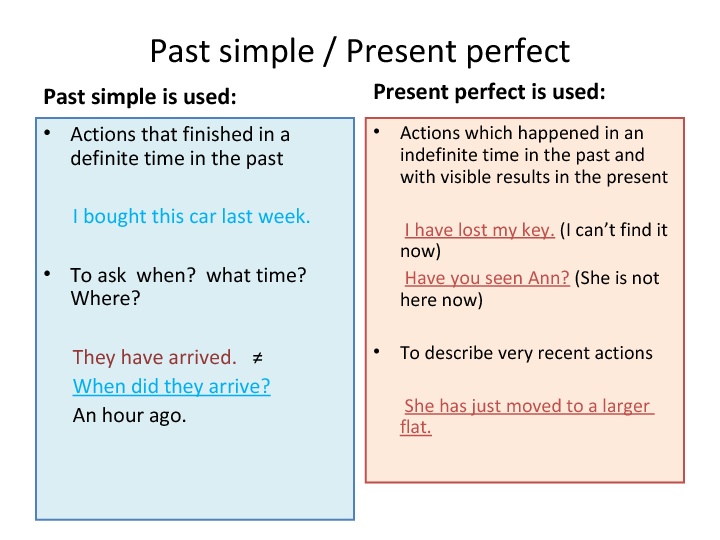
Past Simple vs. Present Perfect


WORKBOOK PAGE 17 AND 18,


jueves, 2 de abril de 2020

2/4

April 2nd    
 WELCOME BACK AGAIN!

UNIT 2A : page 20 what happened?:
Read and complete doing exercise a(try to think about and answer the questions), b (think about the answer) and c (read and answer the questions).

Now pay attention :
 ADJECTIVES ENDING IN -ED OR -ING

Grammar explanation
Adjectives that end in -ed (e.g. bored, interested) and adjectives that end in -ing (e.g. boring, interesting) are often confused.

-ed adjectives
Adjectives that end in -ed generally describe emotions – they tell us how people feel.

I was so bored in that lesson, I almost fell asleep.
He was surprised to see Helen after all those years.
She was really tired and went to bed early.

-ing adjectives
Adjectives that end in -ing generally describe the thing that causes the emotion – a boring lesson makes you feel bored.

Have you seen that film? It's really frightening.
I could listen to her for hours. She's so interesting.
I can't sleep! That noise is really annoying!

Here are some adjectives that can have both an -ed and an -ing form.

amazed amazing
annoyed annoying
bored boring
confused confusing
disappointed disappointing
excited exciting
frightened frightening
interested interesting
surprised surprising
tired tiring
worried worrying
surprised surprising

Now ,go to page 21 and complete exercise 2.Vocabulary.


Copy in your notebook!

Past Continuous Tense: Useful Rules And Examples | Gramática del ...

Now ,complete exercise 4. Practise in the same page.

Page 22 2B : Just taste it !
Look up the words you don't know in a dictionary.Then read and do exercise b,c and d on page 23.
abulary
Page 23 :2 Vocabulary:adjectives decribing food .Complete the exercise.

PAST SIMPLE vs. PAST CONTINUOUS


The past simple shows us that an action was in the past, not in the present.
The past continuous shows us that the action was already in progress at a certain time in the past.

What were you doing at 8 p.m. last night? I was studying.

This means that I started studying before 8 p.m. and I continued after 8 p.m.
The past continuous can also show that an activity was in progress for some time, not just for a moment.

We were cleaning the house all morning.

Past continuous and past simple

When we use these two tenses together, it shows us that the past simple action happened in the middle of the past continuous action, while it was in progress.

While I was studying, I suddenly felt sleepy.

We often use these tenses to show an action interrupting another action.

I broke my leg when I was skiing.
As I was going to work, I saw an old friend.
We were watching television when the power went off.

Can you see a difference in the meaning of these two sentences?

When the guests arrived, Jane was cooking dinner.
When the guests arrived, Jane cooked dinner.

In the first one, Jane started cooking dinner before the guests arrived. We know that because it uses the past continuous. In the second sentence, the guests arrived first and then Jane started cooking.


Now, complete exercise 4.Practice  on page 23 .

For more practice complete pages 15 and 16 from the workbook.

Have a great weekend, and stay at home !


jueves, 26 de marzo de 2020

N4 La punta (Prof.rovitti)

March 26th

Welcome back ! I hope you are all fine !

Today we are going to work with the class book page 18,do the reading exercise and look up for the words you don't know.
Let's finish Unit 1 and reinforce the contents.
Workbook pages 10 to 13.

Write me if you need any help!Stay at home and Take care .

jueves, 19 de marzo de 2020

Nivel 4 la punta


March 19th

Hello!Welcome back to the blog!let's continue....

Class book 1E "Friendly faces"(page 14)


1. Vocabulary:  read and match the highlighted words with their meanings.Try to guess the meaning by the context then if you need use a dictionary.

3.Speaking :
look at the questions and answer describing a Friend. 

Page 15 

Writing:a description of a person 
Do exercises b and c after reading the text.
d. Writing task:
write a desciption of a person you have recently met.You should write between 100 and 120 words.
Pay attention to Tip box!

Workbook:
Page 7-8-9

Write me if you have any doubt!! 


Resultado de imagen de HAVE A NICE WEEKEND CARTEL


martes, 17 de marzo de 2020

adultos nivel 4 la punta

March 17th

Today we are working on unit 1c and 1b from the book.
On classbook page 10,there are expressions and phrases related to like and dislike.

Vocabulary guide:

to be a big fan of someone or something: (to admire someone or something)
can't stand someone or something: (used to say that you do not like someone or something at all.)
to be interested in someone or something
to be fond of :(to like someone  or something a lot)
to be into something : (to like or be interested in something)

Now, go to page 10 an do exercise 1

Prepositions of time :complete the Grammar chart  and do exercise 3.

Practise with the speaking part expressing your likes and dislikes. Then watch the following video https://youtu.be/T5SKbwkNvXc and complete :


TOM 

LIKES:

DISLIKES:

ALEX

LIKES:

DISLIKES:


Page 11,Do exercise 1 and answer the questions and exercise b.
WRITING TASK: write  about yourself, pay attention to the writing tips.

1D PAGE 12
Before reading the text,think about the questions in part a. After reading the text do exercise  on page 13 c and d. Try to figure out  the meaning of the highlighted words.
Exercise 2 vocabulary: once you have done this ,write down the meanings and differences.
Exercise 3:Grammar
Revision of quantifiers,let's see what you remember!do exercises a,b and c. Finally completethe practise exercise.


Ingles 3 Grupo 1 - Villa Mercedes

April 30th. 2020 Hello people!!! It's almost Friday!!! YEAAAAAAAH Today we are going to finish unid 5 and we will do a revision ...